Design
Astra is an empathic large language model therapy companion, and the question I wanted the video to answer was not what it can do but when it should stop. The measure I keep returning to in my own work is whether something gets out of the way, whether you stop noticing the tool and just live, and Astra only makes sense to me if it is built around that restraint rather than around holding your attention. The assignment in HCDE 351 asked for a video prototype, a short film that puts a concept into a real situation so the idea can be felt instead of described, and I decided early that the situation should be an ordinary day rather than a tour of features.
The scenario follows me through a Monday morning. I make coffee, and I am about to leave when I stop at the door without quite knowing why. I sit back down on the sofa and start talking to Astra, and the conversation continues in pieces across the day, the way a real one would, never urgent and never asking me to stay. Over those exchanges Astra works out what I have not said directly, that I have not been sleeping much and have been skipping meals, and instead of treating that as a failure of will it reframes it. I have been telling myself the problem is that I am lazy, and Astra’s reading is that I am not lazy but exhausted, and what I need is not more discipline but a real break. The day ends with me accepting that and going to bed, which is a quieter resolution than a product video usually allows itself.
The next morning repeats the first, the same coffee, the same light, the same walk toward the door, and this time Astra asks once whether I need anything before I go. I smile, say nothing, and leave. That silence is the part of the scenario I care about most. The point is not that Astra has been switched off but that it has done its work and now has no claim on my attention, a tool I am free to not answer, which is the opposite of how most software treats the people using it.
Two formal decisions carry the concept. Astra has no voice, and whenever it speaks the image cuts away from the room to a full screen title card of its words, so its presence reads as something closer to a thought than to an assistant performing warmth. I also chose not to show a phone or a screen it lives on, and to let it feel ambient rather than tied to a device, which I knew was a risk and will come back to in the analysis. The slice of life form was deliberate for the same reason the silence is. A dramatic story about a breakdown would have made Astra feel like an intervention, and I wanted it to feel personal and ordinary instead, present in the room without ever raising its voice.
Storyboards
The storyboard maps the scenario as a sequence of beats, the shape the film moves through rather than a shot by shot plan. I am keeping it spare on purpose, because the story is carried by a few simple images that repeat, and a board with too much detail would hide the thing that actually does the work, which is how little changes between the two mornings.
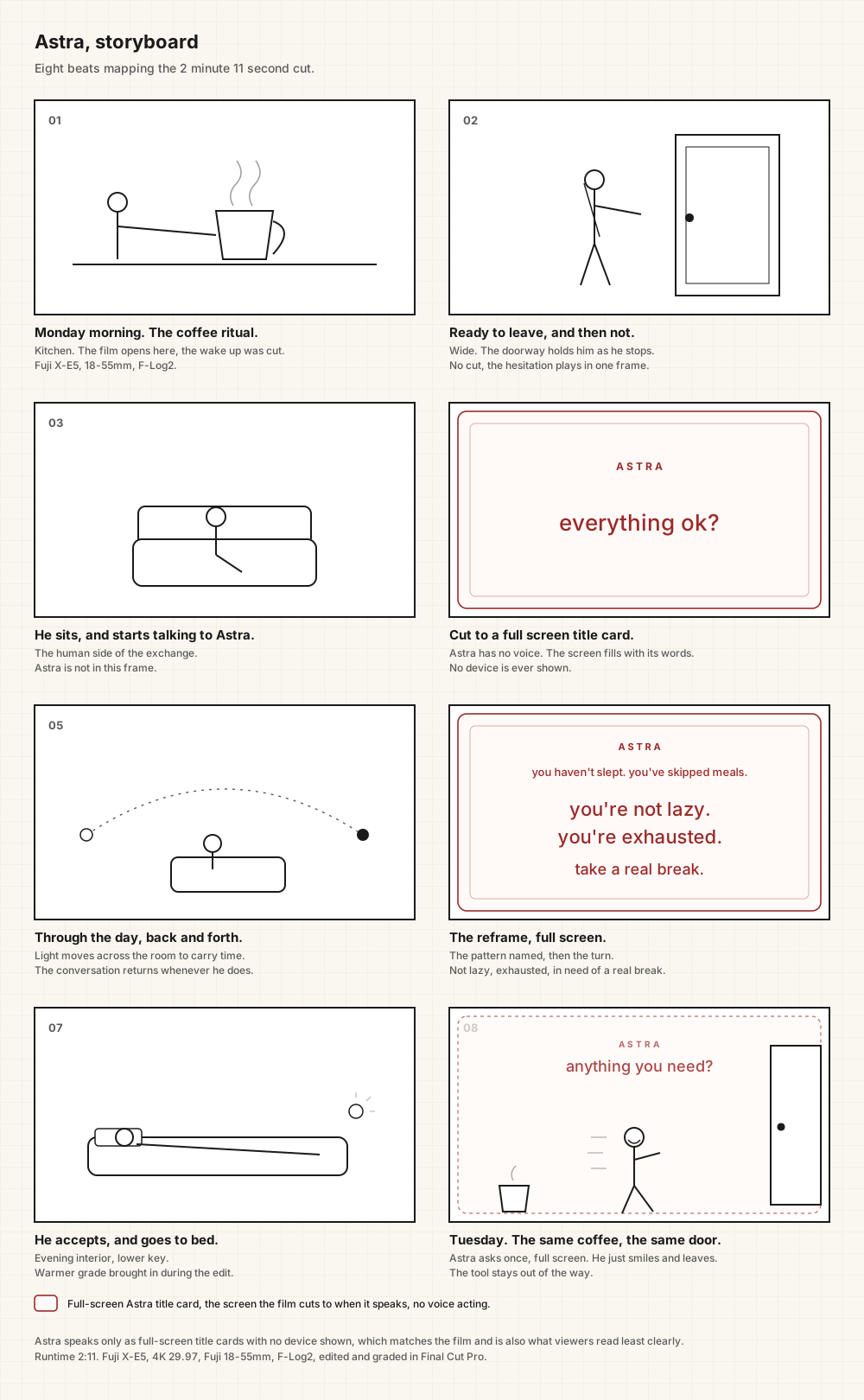
The eight panels run in order, the Monday morning coffee the film opens on, the stop at the door, the conversation beginning on the sofa, the screen filling with Astra’s words, the back and forth carried by shifting light, the reframe shown full screen, the night, and the Tuesday rhyme that closes on the figure leaving without answering. What the sequence makes visible is how much of the story is told by repetition, the second morning only means something because the first one was shown plainly enough to be recognized again.
The Film
The film runs two minutes and eleven seconds. I shot it on a Fuji X-E5 at 4K and 29.97 frames, with the Fuji 18 to 55mm lens, recording in F-Log2 so I would have room to grade later, and I edited and graded it in Final Cut Pro. It was made over two days, one to shoot and one to cut, in my own apartment, the living room for most of it and the kitchen for the coffee. I was the only person in it, which meant acting and directing and operating the camera were the same job, done one take at a time by setting a frame, stepping into it, and checking it after.
The cut is built around two mornings that are filmed almost identically, so that the small difference on the second one, Astra asking and me not answering, carries the whole ending without a line of dialogue to explain it.
Analysis
The in-class critique was positive. What came back most consistently was that the restraint read, that the ending landed as confident rather than unfinished, and that the reframe from lazy to exhausted was the moment the concept stopped being an idea about software and became something people recognized from their own lives. No one argued with the premise. The criticism that did surface was not about whether the scenario worked but about legibility, specifically that it is not obvious what Astra is or where it lives, and a few people read it as an inner voice rather than a product until the title cards made them reconsider.
Beyond the crit, I wrote a short survey around the four criteria the assignment evaluates against, feasibility, usability, desirability, and impact. The survey asks what the viewer thinks Astra is and where it lives, whether the conversation was clear without ever hearing Astra speak, whether they would want something like this in their own day, whether the it felt true or scripted, and whether the silent ending read as resolution or as the film giving up.
A classmate answer that the interaction is legible and the pacing honest, while pressing hardest on feasibility, asking how a companion with no device and no sensors would know about the missed meals and the lost sleep, which is the same gap the crit found. One viewer resist the premise at first and then concede that the film is desirable precisely because Astra withdraws, that the part they expected to dislike, a therapy app, is disarmed by the part they did not expect, an app that can take a step aside. Another viewer talked about the impact before anything else, naming the reframe as the line that stayed with them and saying the ending felt true rather than tidy. Across those responses the pattern is consistent enough to be useful, desirability and impact are where the scenario is strongest, and feasibility and usability are where it is thinnest, both of them tied to the single decision to keep Astra ambient.
Feasibility is the weakest claim the film makes, because the empathy that carries the story depends on Astra noticing patterns across days that the prototype never explains how it would sense, and the ambient framing I chose for emotional reasons is exactly what makes the technical question louder. Usability is mixed in a way I find more interesting than a clean pass would have been, the conversation itself is clear and the title card device works, but legibility of what Astra is, the thing a real interface would settle in seconds, is left open by the form. Desirability is the strongest result, because the slice of life keeps the concept from feeling like an intervention and the restraint is the feature people actually wanted. Impact is close behind, since the reframe and the silent exit are doing the real argument, that a tool can change something and then decline to ask for more, which is the claim I most wanted the scenario to make and the one it makes most cleanly.
My conclusion is that the scenario is effective at the thing it set out to do and honest about the thing it does not resolve. It communicates the feeling of Astra and the stance behind it far better than it communicates the mechanism, and since the assignment is a video prototype rather than a technical one I think that is the right move.
Reflection
I chose a film about restraint partly because it is what I believe about design and partly because it was the harder thing to do in two minutes. It is easy to make a concept look good when the concept is loud. A scenario whose climax is a person going to bed, and whose final beat is someone choosing not to speak, only works if the small things are right, and that turned out to be most of the difficulty. This was the first real film I have made, and the difference between knowing what I wanted a cut to feel like and knowing how to make Final Cut Pro produce that feeling was wider than I expected, so a large part of the two days went to learning the edit rather than the story. The clearest thing the edit taught me was to lose something that works for the sake of the whole was most of what the second day actually was. Grading was the part that came easily, because the discipline of reading F-Log2 and shaping an image is close to the raw photo editing skill I already knew, and the X-E5 gave me enough latitude that the look I wanted in the evening scenes was a decision rather than a fight.
The biggest frustration was on directing myself. Working alone meant every take was set, performed, and judged by the same person, which removes the one perspective that would have told me when a beat was not reading, and I suspect the legibility problem the crit found is partly a symptom of having no one in the room to say they did not understand what Astra was. What I wish I had known at the start is that the ambient framing I was most attached to conceptually was also the decision most likely to cost me clarity, and that I could have kept the feeling and still given the audience one honest cue about what they were looking at. I am not sure where that line is yet, between making Astra legible and making it loud, and the part of this I am still sitting with is that the choice I am proudest of and the one the room found weakest are the same choice, which probably means the next version is not a fix but a different attempt at the same idea.
AI used to review and edit this log. Claude was used to create the summarized version of the storyboard from my sketches, which improved the organization of the presentation.