Prototype
Our group created a gesture-controlled glove that senses hand gestures to control presentation slides. We used wizard-of-oz prototyping by having a wizard control the presentation slides, mirroring the user tester’s actions.
From our user testing, we wanted to evaluate desirability and usability. For desirability, we would evaluate whether the user found the glove helpful and whether it would be useful for presentations. As for usability, we wanted to see whether the gestures were intuitive for the slide control. From this prototype, we aimed to answer the research question: Could gesture-only interaction for slide presentations be enough for users to have an intuitive and reliable experience?
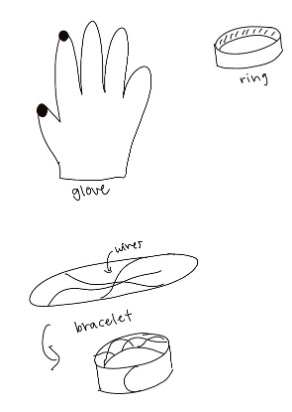
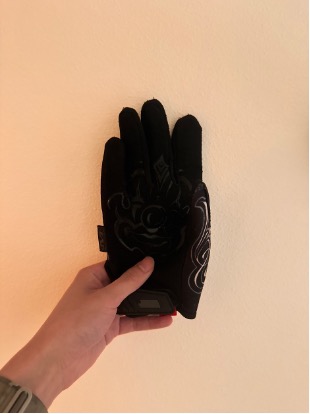
Left: Sketches of gesture-control devices. Right: The glove we used in the user test.
Our initial sketches included gloves, bracelets, or rings as devices that “sensed” the user’s movements. Because of resource and time constraints, we chose the glove as our gesture-sensing device.
Our user testing plan was to use a meeting room with a TV to enlarge the presentation slides. In the room were the facilitator, user tester, scribe, and wizard. We informed the user tester that there were two scribes instead of one. The other scribe was the wizard, who used a Bluetooth keyboard to control the slides.
Our facilitator introduced the prototype and tasks to the user. Here is the script outline we roughly followed:
[welcome!!!] Thanks for participating
I’m [name], intros etc. We have two notetakers …
Do you consent to being video recorded …
We’re going to be testing a gesture-controlled prototype for navigating slide presentations.
We have three tasks for you to do.
Please announce what you are going to do before each action. For example (announce, going forward a slide, do action)
These are the gestures for each task: [show each gesture]
Tasks:
Going forward: rotate wrist right
Going back: rotate wrist left
Playing video: (same action as going forward)
Thank you for participating!!
After the tasks, the facilitator asked the user for feedback, which will be addressed in the analysis.
Analysis
We collected some quantitative data, such as the reaction time, number of successes, and number of failures.
| Wizard | Tester | |
|---|---|---|
| Reaction Time | 1 sec controlling video, otherwise 0.2 sec | 0.5 |
| Fail | 2 | 2 |
| Success | 5 | 5 |
Based on our user testing, the user successfully completed the forward/backward slide navigation tasks. There was a little struggle wth playing the video.
The user tester found the controls responsive and easy to use, and did not require any exaggerated movement to trigger. This addresses usability, as the gesture controls made sense for the user. As for desirability, when asking the user if this was something they would want to use, the user said it could be helpful for presentations. Other valuable feedback from the user included changing the gesture for playing the video to be different than going forward a slide.
To summarize feedback from user testing and in-class demo, we found that the gestures worked well, as it was observed that the user quickly got used to the gestures. Something that could be improved is including different gestures for playing the video versus going forward a slide, as it was noted in both user testing and in-class feedback that combining the gestures muddled the purpose of the gesture. Something we could do to change this is to include more gestures for different purposes, like playing a video. From this feedback, we concluded that the prototype was effective in seeing the usability of the gestures and the desirability of the product. However, we would need to future iterate to make improvements, like adding different gestures.
Feedback from class
TLDR: Glove used to run Powerpoint slide (go back and forth and play video on slides)
- Does the prototype appear to be useful for making design decisions?
- It seems useful as it would be hard to create an electronic glove for the actions.
- Prototype was useful as you could see participants initial thought for each response
- Is it really doing the work? (genuine reactions)
- The wizard of Oz prototype worked well with the user quickly grasping the gestures and the wizard responding quickly to make it seem realistic.
- What (if anything) is confusing?
- Maybe combining gestures for multiple functions can muddle the purpose of one function or bury the other functions if one function is used more than the other. Basically having the next slide and play video as the same gesture can be a bit confusing.
- It seems there were no preset gestures, but I wonder if having a different gesture for play, as the user used the same gesture as going forward
- What could be improved?
- Prototype could show how this could be used in a real world scenario rather than just showing the controls. Testing doesn’t really show any results besides showing that the controls work.
- Going forward and playing video gestures are the same, making it a little confusing.
- Do you have questions the video didn’t answer?
- I think the video answered the questions it asked, however I wanted to see if the user had any other ideas
- Did the user find this more convenient than using a clicker or laptop, I wanted to see if they would use the device